Streamlining the Journey from Dev to Prod
Scaling an enterprise data platform often feels like a delicate balancing act between quick development and operational stability. When organisations feel that making a decision takes too long, fragmented vendor silos, or heavy reliance on single individuals, the root cause is rarely a lack of data - it is the friction in how data moves. Building a sustainable, future-proof data environment requires getting rid of messy, hard-coded setups and laying down a clean, reliable pipeline from the start.
A proper setup relies on a clean foundation. By leveraging a unified Medallion Architecture (you can read more about it in our previous blogpost), we create a smooth motorway for our data. Automating data ingestion with Fabric shortcuts, API calls in orchestrated notebooks, or Azure Function Apps, to name a few ingestion methods, keeps things running like clockwork without wasting budget.
The real secret to smooth promotion from development to production lies in environmental parity. Rather than manually building target workspaces, Azure Deployment Pipelines can automatically spin up identical tri-environment infrastructure - Dev, Test, and Prod - complete with dedicated storage accounts, Fabric capacities, and key vaults. When all three environments mirror each other down to the ground, you can stop sweating over whether a release is going to break things in production.
To make code move effortlessly across these lifecycle stages, engineering teams must enforce one non-negotiable rule: never hardcode environment paths. Dynamic Fabric Notebooks should transform raw files into structured Silver tables without explicitly tying themselves to specific ABFSS file paths, workspace IDs, or lakehouse GUIDs.
Native packages like NotebookUtils make this easy by dynamically resolving file systems, reading environment variables, chaining processes, and securely retrieving secrets on the fly.
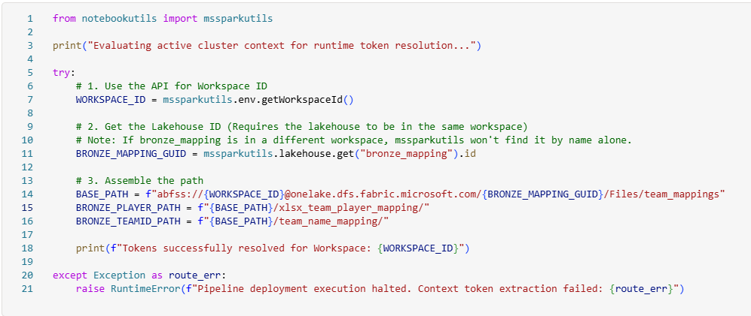
With dynamic code and structured infrastructure in place, moving updates forward becomes a simple administrative task rather than an engineering headache. Fabric Deployment Pipelines allow teams to link workspaces across Dev, Test, and Prod, selectively promoting only validated artifacts.
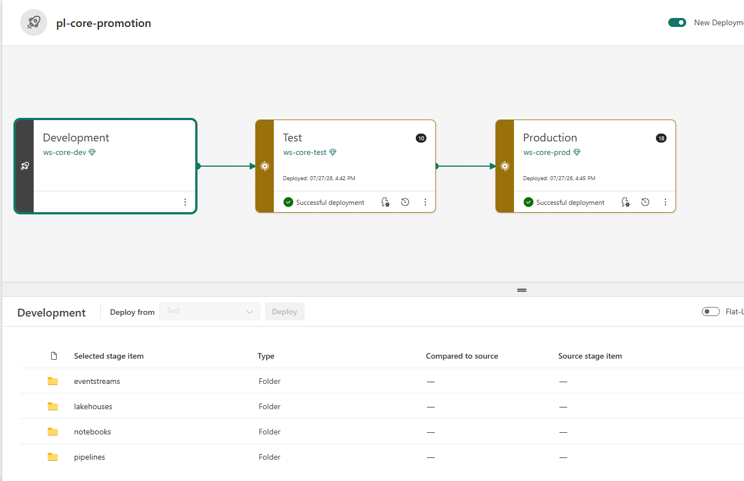
This controlled, modular workflow empowers teams to iterate fast, reduce decision latency, and maintain a robust, enterprise-grade environment built to last.
If this sounds like the kind of friction your team is dealing with, we'd love to chat through it with you. Get in touch and let's talk about what a smoother Dev-to-Prod journey could look like for your organisation.