

Imagine being able to ask a question about your business data in everyday language and receive a useful answer immediately.
That is the idea behind chat with your data. Instead of relying solely on filters, visuals and predefined reports, users can ask questions in natural language to help them discover insights, understand trends, or find relevant information more quickly.
They might ask:
Which products performed best last month?
What is driving the change in our margin?
Can you summarise the key information in this report?
Where can I find trusted data about this customer segment?
It is a more intuitive way to access insights, but there is an important consideration: the quality of the answer depends on the quality and context of the underlying data.
Trusted answers start with prepared data
This was one of the biggest lessons from our first Chat with Your Data in a Day workshop in September.
Successful conversational analytics is not simply about writing better prompts. Copilot also needs to understand what your data means within the context of your organisation.
Clear business definitions, meaningful descriptions and familiar terminology all help Copilot interpret questions more accurately. Organisations can also provide additional instructions and context around how particular measures should be understood.
This does not mean preparing every piece of data at once. A practical starting point is to identify a valuable business use case, understand the questions users need answered and focus on the most relevant data.
Does this replace dashboards?
No. Chatting with your data gives people an additional way to access and explore information.
A dashboard can provide an established view of performance, while a conversational experience allows the user to ask more specific follow-up questions. The two approaches can work alongside each other.
Testing and human oversight also remain important. Copilot’s responses can vary, so models and answers need to be reviewed and refined before conversational analytics is introduced more widely.
Learn by doing
Our first workshop brought these ideas to life through demonstrations and hands-on labs.
Participants explored how Copilot works with Power BI, the challenges caused by unprepared data and the steps that can improve the quality of its responses.
One attendee described the workshop as providing:
clear and practical insights into how Copilot integrates with Microsoft Fabric, along with realistic demonstrations and well-structured use cases."
Join our next workshop
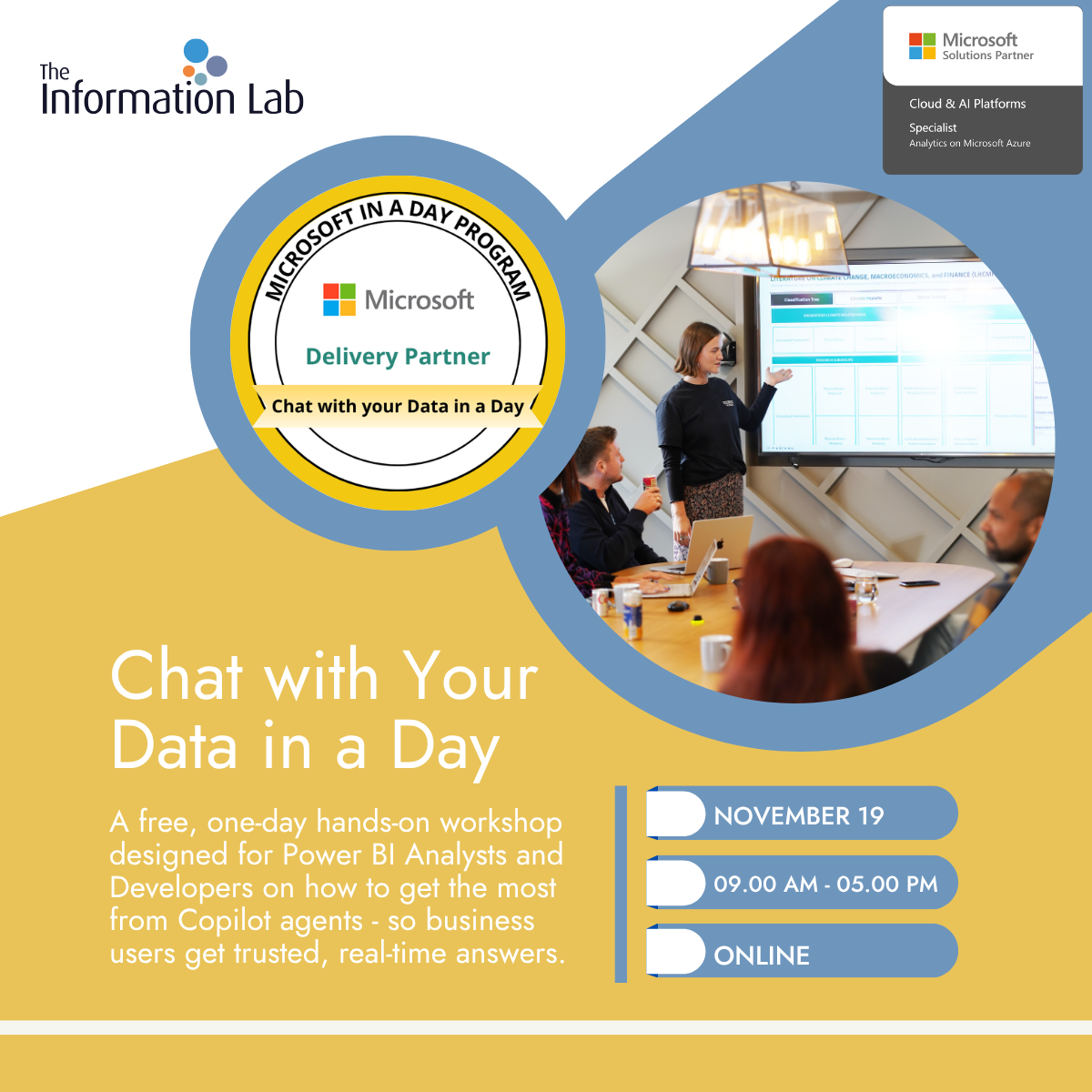
The next free Chat with Your Data in a Day virtual workshop takes place online on 19 November 2026.
Designed for Power BI Data Analysts and Developers with previous Power BI experience, the session will help you:
prepare Power BI models for conversational querying
provide Copilot with clearer business context
test and refine the answers it produces
explore the Power BI Copilot experience
understand how Fabric data agents can support conversational analysis
Whether you are beginning to explore Copilot or considering how conversational analytics could work across your organisation, the workshop offers a practical introduction to both the possibilities and the preparation required.
Find out more and register for Chat with Your Data in a Day
Author
Débora Contente is a Data Consultant and Trainer at The Information Lab Ireland, with a background in Computer Science and extensive experience in data analytics, visualisation, and business intelligence. Having begun her career through The Data School at The Information Lab UK, Débora developed expertise in Tableau, Alteryx, Power BI and data storytelling before specialising in Microsoft's modern data platform. Today, Débora delivers a range of highly rated hands-on training programmes, including Chat with Your Data in a Day, Fabric Analyst in a Day, and Dashboard in a Day workshops. Through these sessions, she helps organisations understand how to unlock the power of Microsoft Fabric, Power BI and AI-driven analytics to make better, faster decisions with their data. Passionate about empowering users of all technical levels, Débora's goal is to help people gain meaningful insights from their data as quickly and efficiently as possible, turning complex concepts into practical, real-world solutions.